A conversation with Oscar Murillo about his new show „Collective Osmosis“ in Germany, his obsession with Claude Monet, cycling trip through Europe, the beauty of collaborative works and the radicality of free museums
Oscar Murillo is known in the art world for his comet-like rise and rebellious streak. The Colombian born, London based artist and Turner-Prize winner, first turned heads in the US when mega-collectors Don and Mera Rubell presented his works in 2012 in their private museum in sync with Art Basel Miami Beach. Prices for his paintings soared, everybody (including Leonardo diCaprio) wanted one of his raw neo-abstract-expressionist canvases. David Zwirner took him under his wings. For his first solo show at Zwirner’s New York gallery Murillo didn’t show paintings, he installed a fully functioning candy factory and served chocolate covered marshmellows to the irritated crowd. It was a reference to his working class background and to his parents, who had worked at such a factory in Colombia. A year later at the Venice Biennale his intimidating black canvases were prominently covering the entrance of the International Pavillon.
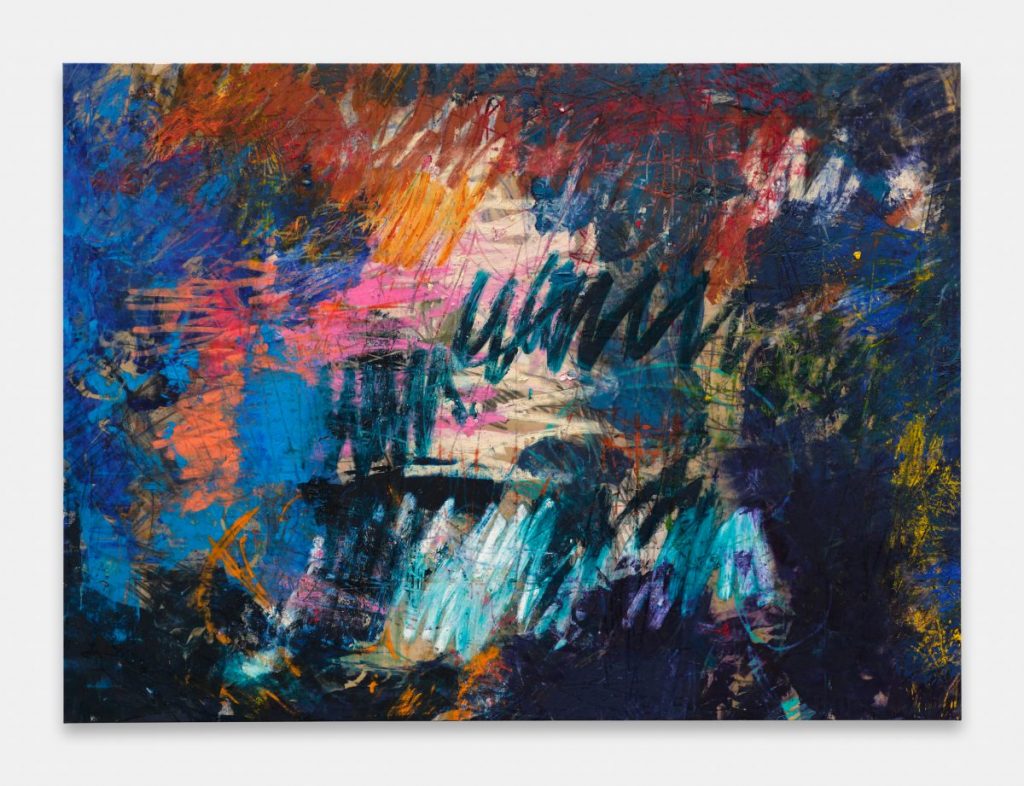
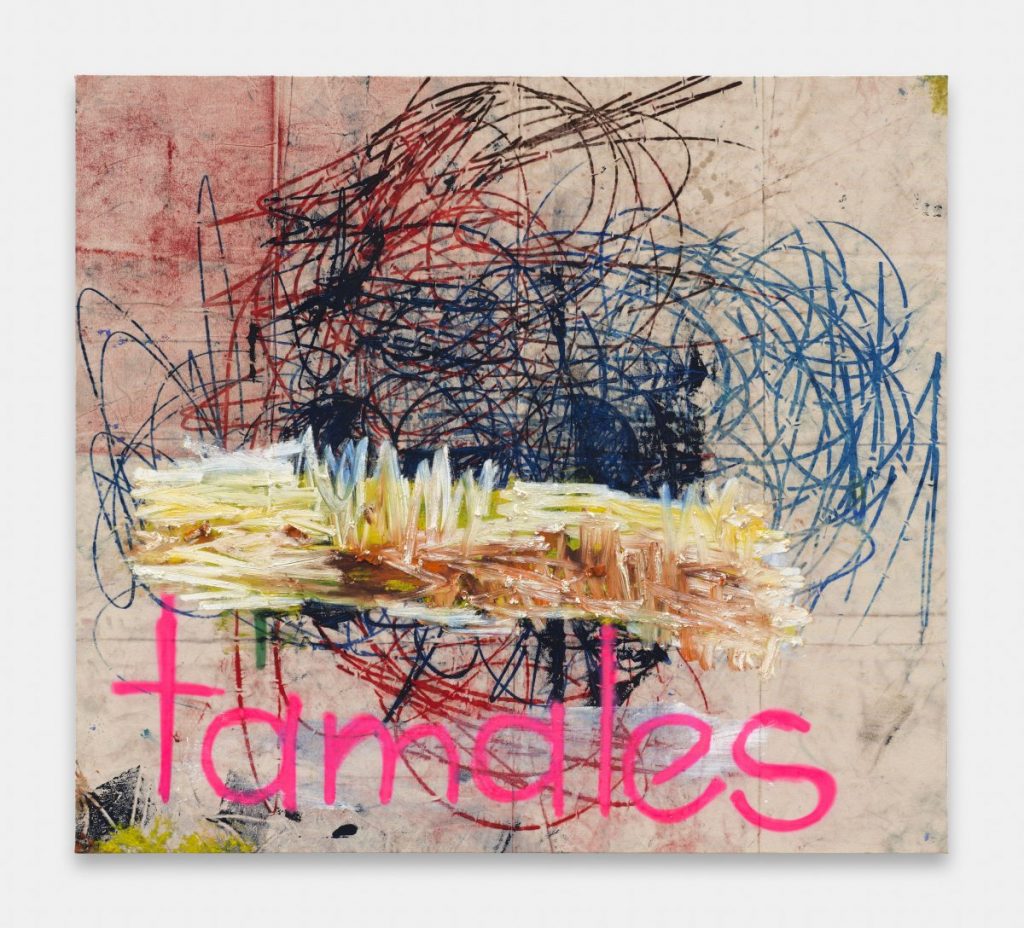
For his large format abstract paintings Oscar Murillo has developed a unique process of „mark-making“, He does not use brushes, working instead with a trowel, and solid oils sticks. A key moment in the production of the paintings is his use of a long metal stylus which he pushes energetically over the top of a second raw canvas that covers the painting on the floor. Working in zigzags and circular motions and making use of both positive and negative transfer techniques, the stylus imprints dramatic graphic lines on the canvases. Murillo also works with participatory projects, video, sound and installation to examine ideas of collectivity and shared culture.
He had major museum exhibitions in New York, Stockholm, Tokio, Hamburg, Munich, London, and Sao Paulo. Now Murillo shows his works in Potsdam, a German town close to Berlin with lots of history. The provincial capital, once was the center of the Prussian empire, later the cradle of Germany’s film industry, bombed to shreds during WW2, the place where Churchill, Truman and Stalin after the war signed the treaty that would lead to the division of Germany and the Cold War. It was at Potsdam’s Glienicker Brücke where the legendary spy exchanges took place. After the the Wall came down the town with its crumbling palaces and lake-front villas attracted investors. Museum Barberini and Das Minsk, where Murillo’s show takes place, are two relatively new institutions. Both museums are financed by SAP founder and philanthropist Hasso Plattner. For Museum Barberini, which houses his collection of French Impressionist masters and stages blockbuster exhibitions on Munch, Kandinsky, Picasso or Van Gogh, Plattner reconstructed a historic palace in the old city center. Das Minsk, with focuses on contemporary art and East-German history, is located in a stylishly refurbished former GDR restaurant from the 70s.
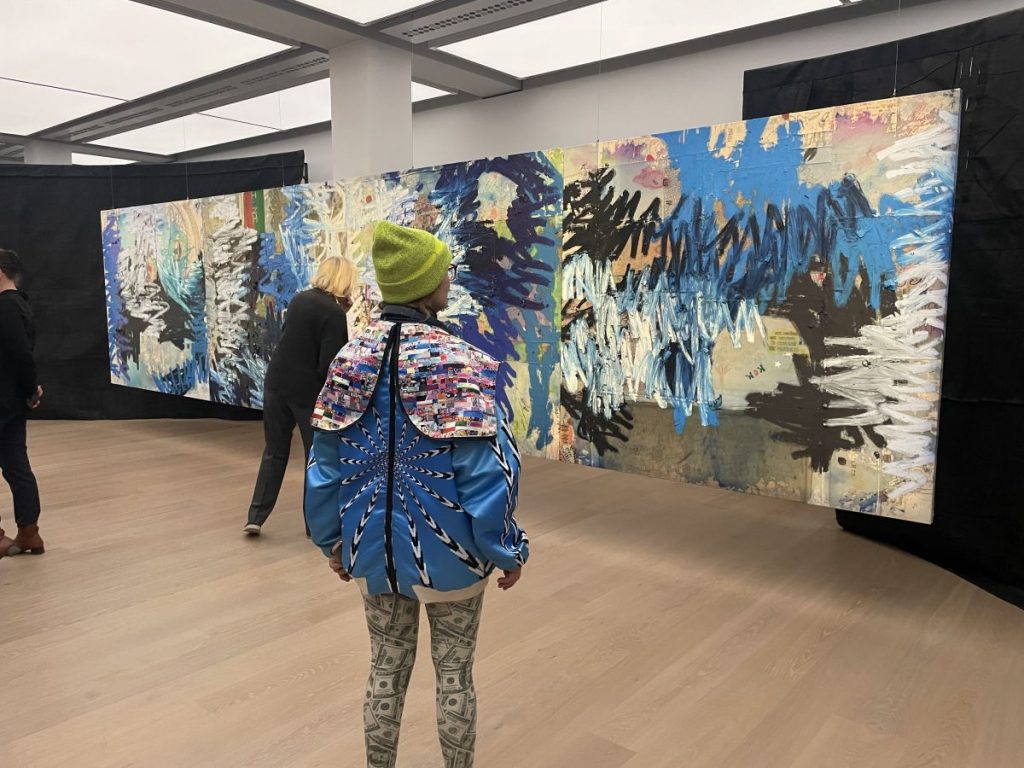
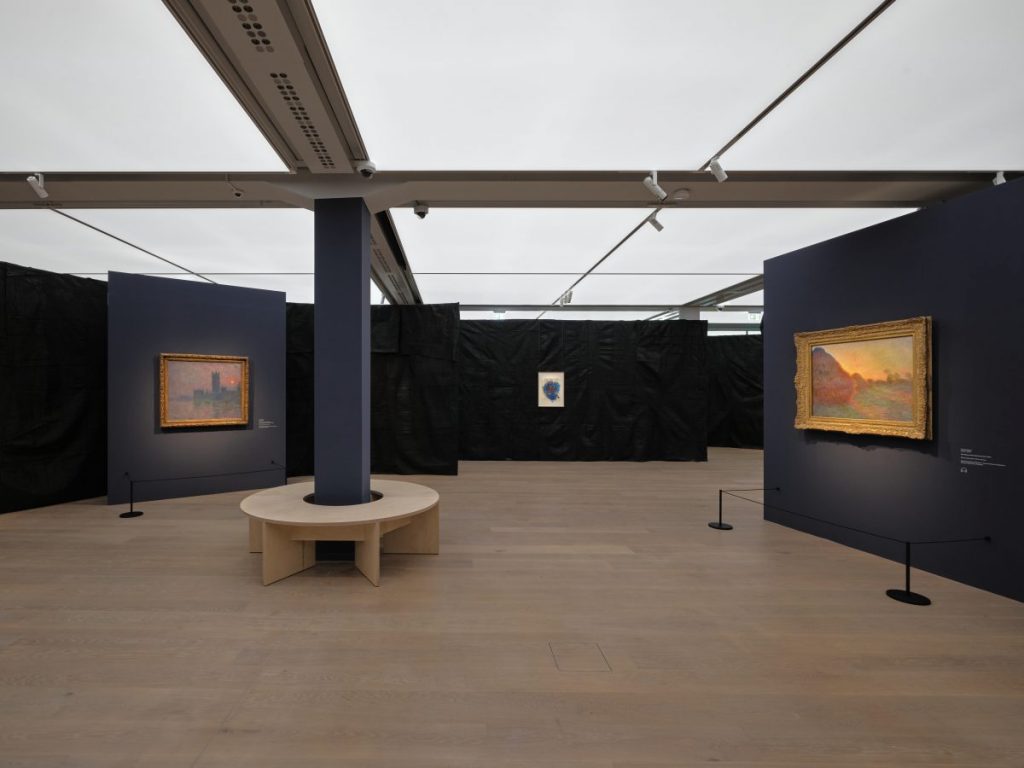
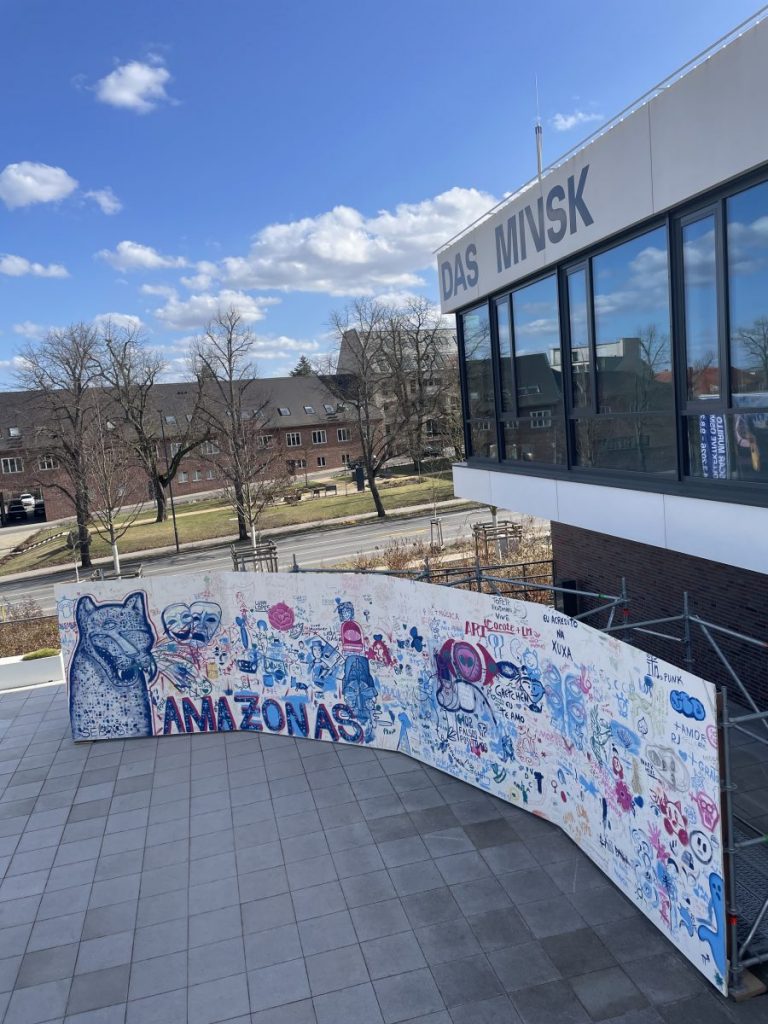
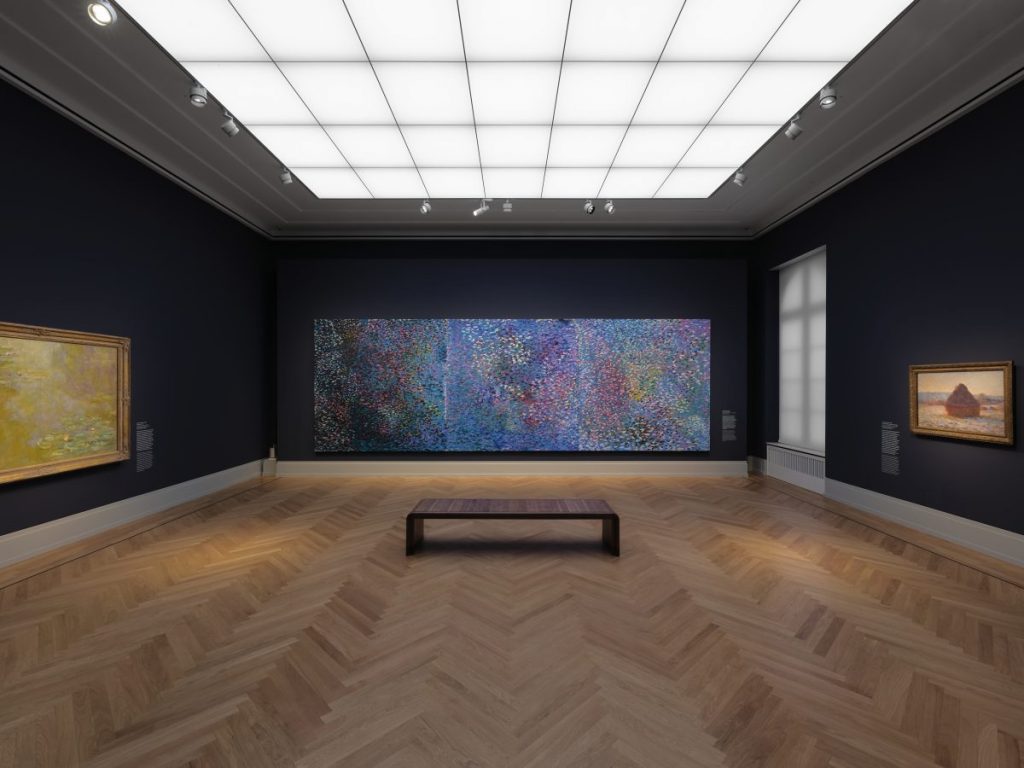
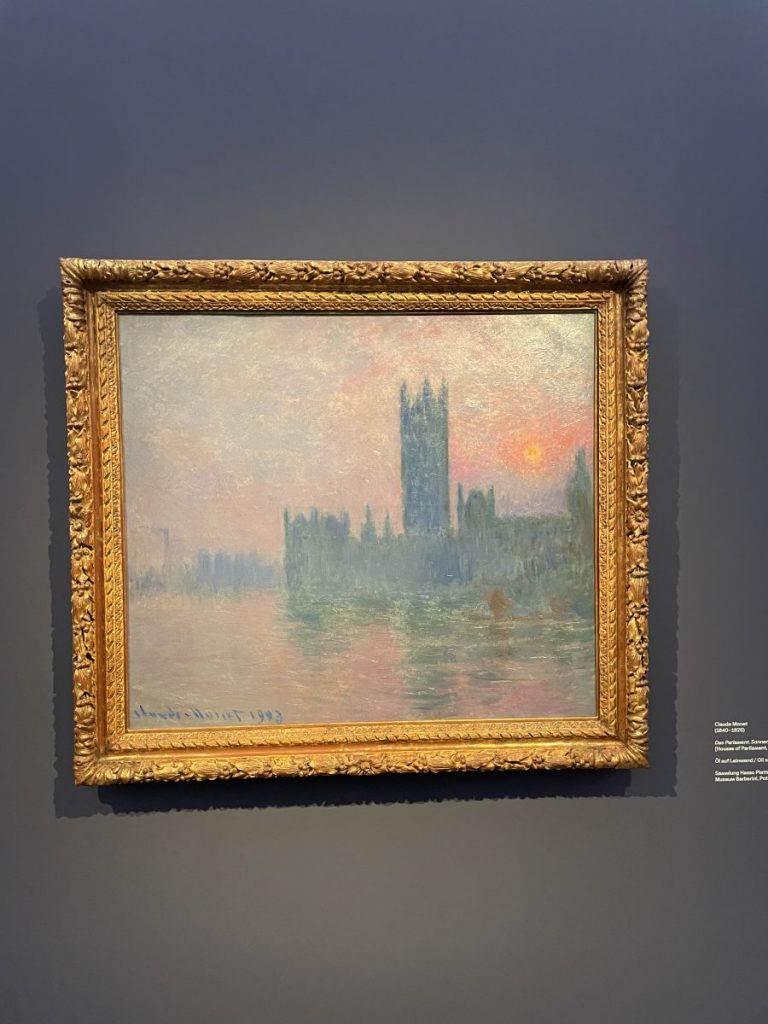
With his show „Collective Osmosis“ Murillo takes a deep dive into the world and vision of Impressionist master Claude Monet. His hypnotic abstract paintings hang side by side with Waterlilies and Haystacks. Monet’s romantic image of the British Parlament is surrounded by The Institute of Reconciliation, a maze of Murillo’s signature burned black canvasses. A surprising artistic dialogue that infuses impressionist modernism with a post-colonial vibe. The show also offers insights into Murillo’s ongoing participatory projects all over the world. Visitors can browse through the Frequencies archives and look at the fascinating marks, doodles and drawings schoolchildren from Argentina, China, Germany, India, Palestine or USA left on their canvas covered desks. And the show invites people to get creative themselves. The museum terrace has been turned into an open studio for „Social Mapping“ sessions – Murillo’s idea of a playful, universal messaging board.
I toured the show with the artist. Then we sat down for an interview.
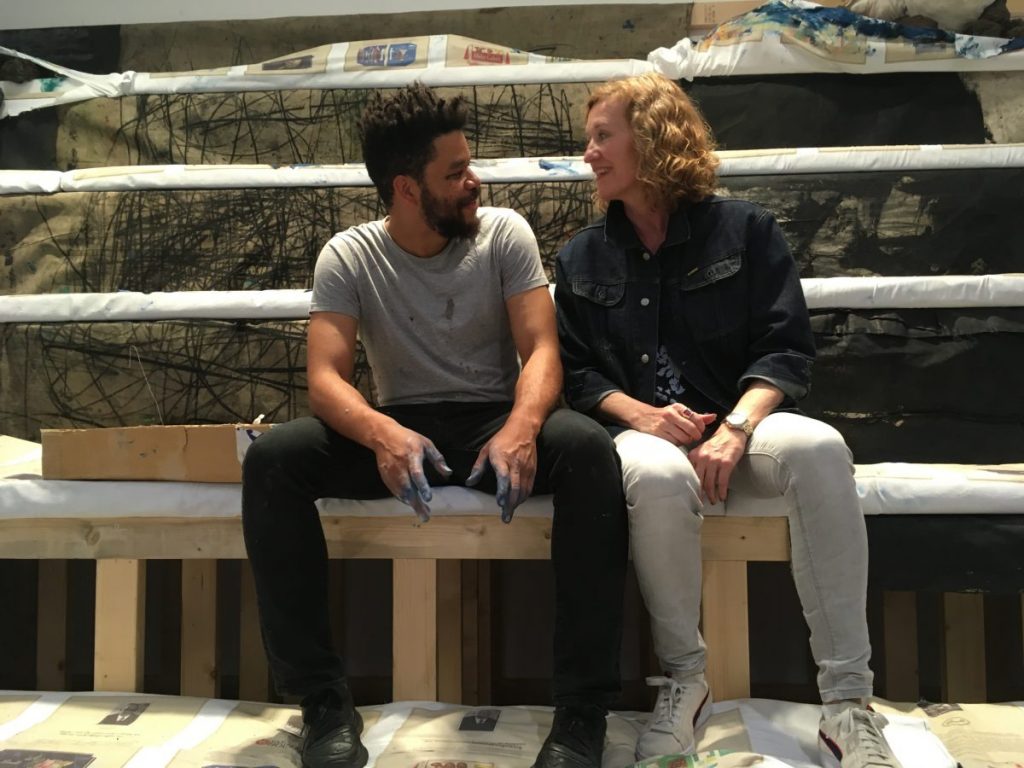
UT: Can you tell me a little bit about how this exhibition came about? I understand you knew curator Anna Schneider from an earlier collaboration at Kunsthaus München and that she approached you with the idea for this show. I also know that you have a special interest in the work and vision of Impressionist painter Claude Monet. As it happens, Museum Barberini has key works of the French Impressionist in its collection. Did that spark your interest?
OM: I must admit, I didn’t know much about Potsdam, its museums and history before Anna brought me here. She was really the catalyst for this project. I came to Berlin for the first time in 2006 when I was 20 years old. But the kind of depth of understanding of the historical facts, the breakdown caused by Second World War and the post-war developments in Europe, happened much later – on a cycling trip! I love bicycle-riding and three years ago I went cycling for a month with a group of friends, starting in Belgium, weaving in and out of France, Germany, Luxembourg, Switzerland all the way to Italy. When you travel with a bike through the countryside, you start thinking about the freedom of movement and the history of national borders. And about agriculture, something I’m very interested in due to my own family history. I come from a family of sugarcane plantation workers, grew up in a rural area in Colombia and experienced the brutality of the Colombian system. I’m also familiar with the dynamics between urban and rural life, and how migration movements to the big cities often destroy rural communities.
How did you come up with the title for the show „Collective Osmosis“? In science „osmosis“ discribes how water particles pass through a semipermeable membrane from a less concentrated solution to a more concentrated one, until equilibrium is reached. What exactly do you mean by it in the context of art?
For me „Collective Osmosis“ is a metaphor for a certain kind of elasticity. I want to express that the structures that form our life – politically, economically or geographically – can be disolved. After all we are all humans, we stand here as one humanity. It’s about equality and the world as a whole. It also stands for the opening of the museum, creating permeability between indoor and outdoor spaces, between museum and city, between Potsdam and the world. It’s also about the elasticity of the history of an important artist like Monet, and how what he saw and painted more than a hundred years ago, can shape our view of the world today.
Claude Monet seems to be on your mind for quite some time. I saw your first paintings referencing his work 2019 in a gallery show at David Zwirner’s in London. Can you explain how you became interested in the Impressionist painter?
I think it started in my youth when my family emigrated to Great Britain. I had a love for colors and painting. And the museums in London offered the opportunity to see works by Monet, the Fauves, the Blaue Reiter group – all these artists who had a wild relationship with color. I was fascinated even though biographically I didn’t have much in common with these painters. Much later in my artistic practice Monet came back to me. I was thinking about his eye disease. Monet suffered from cataracts. But that didn’t stop him from painting. In fact with this impairment he created his most beautiful works. I had this idea of Monet as kind of an archetype of an individual who was suffering in the twilight of his years as a painter in his beautiful garden in Giverny. His impaired vision enabled him to look beyond the surface of things. So Monet’s cataracts serve as a vessel for dealing with pain and darkness – for finding compassion through the suffering of this great master. I think precisely because of Monet’s significance for culture – and particularly painting – that I want to hold him as a bearer. Behind all beautiful things lies suffering. These reflections on Monet showed me a way to enjoy virtuosity and beauty again.
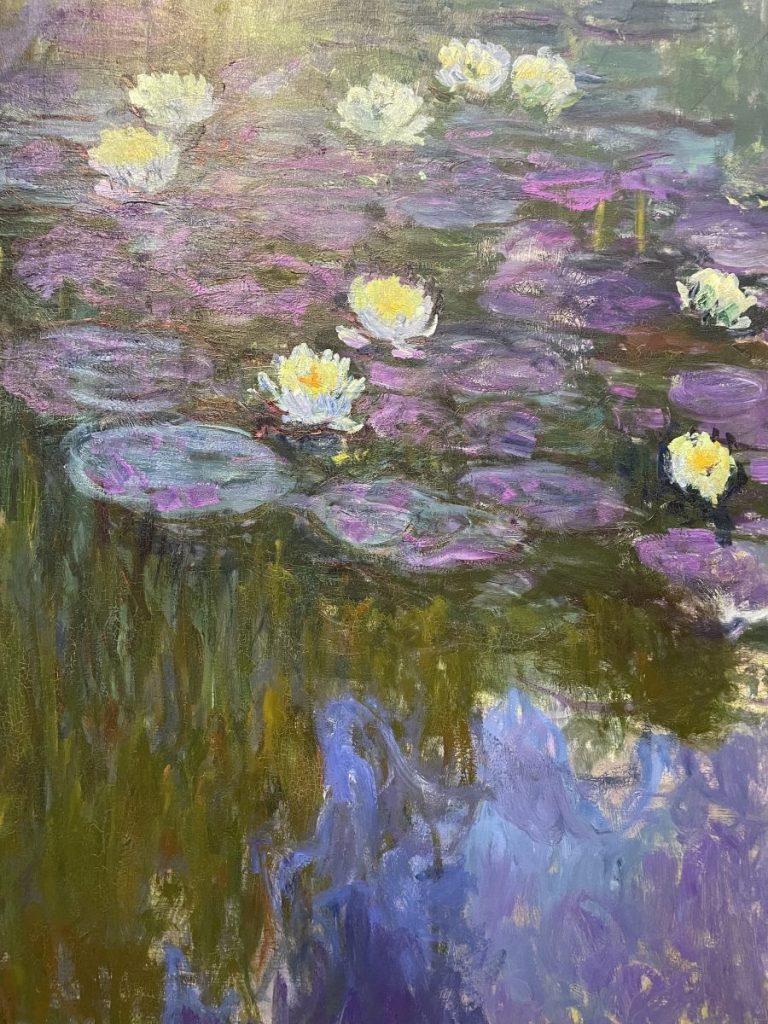
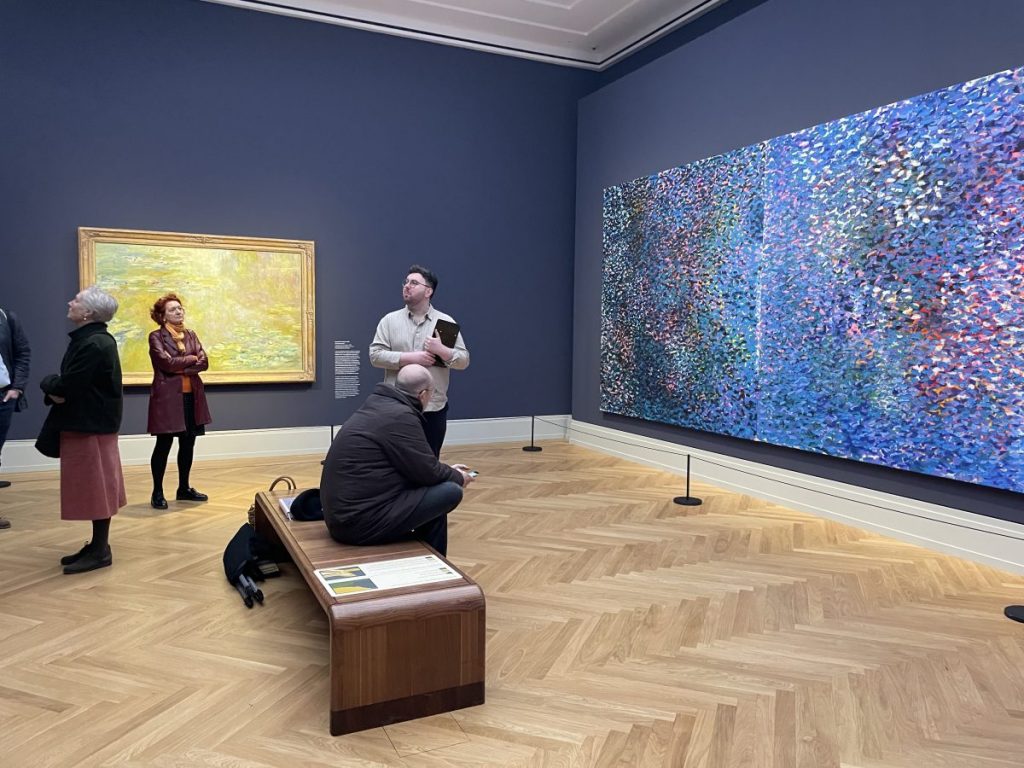
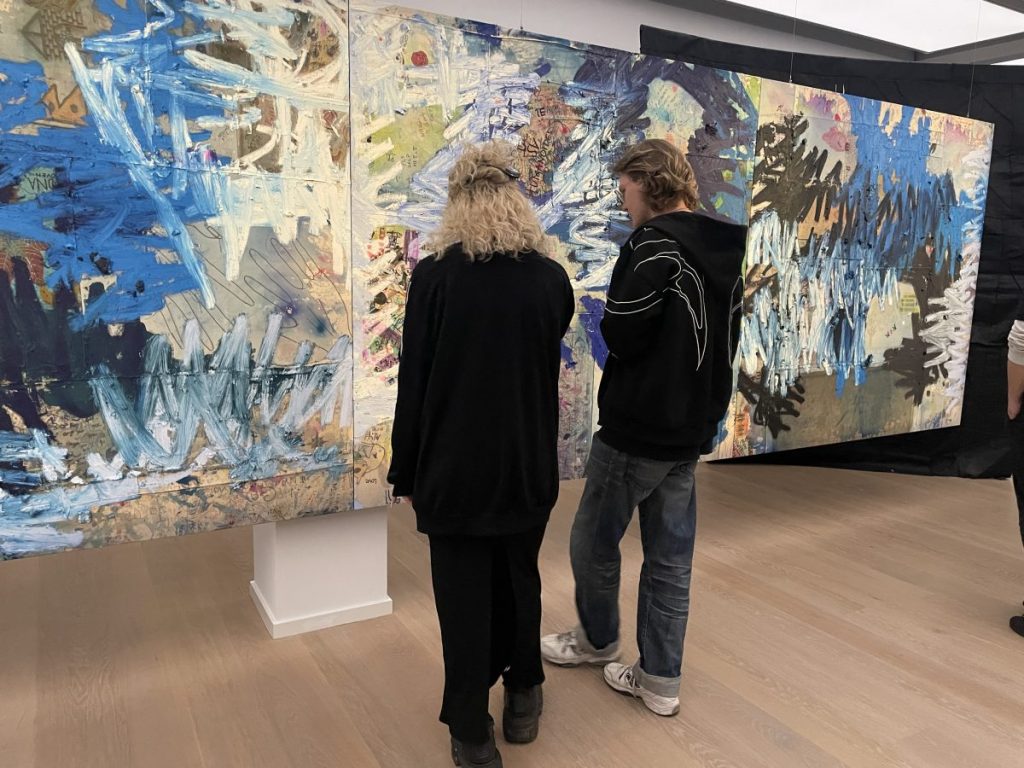
Now your Monet-inspired paintings occupy a prime spot at Museum Barberini, a temple of Impressionist beauty. The triptych surge (social cataracts) hangs in a gallery space usually reserved for Monet’s Water Lilies. How does that make you feel?
It’s such a privilege, of course. It’s also interesting to see what those paintings do to each other aesthetically. That large triptych is really about the virtuosity of mark making, you know. It shows how I work in this kind of intuitive way with layers of color and how those colors collide. The painting is like a projection, like when you're looking through a microscope at a detail of an image. It’s rather unsettling because it seems to flicker, you can’t really focus. So you have that experience of movement. And at the same time, when you turn to Monet’s paintings in the room you see a different kind of complexity. Somehow the intensity of scale and texture, it feels like it does something to the other paintings. Like, how you see them. The marks on my paintings are so thick. And that unsettles maybe the subtlety of Monet.
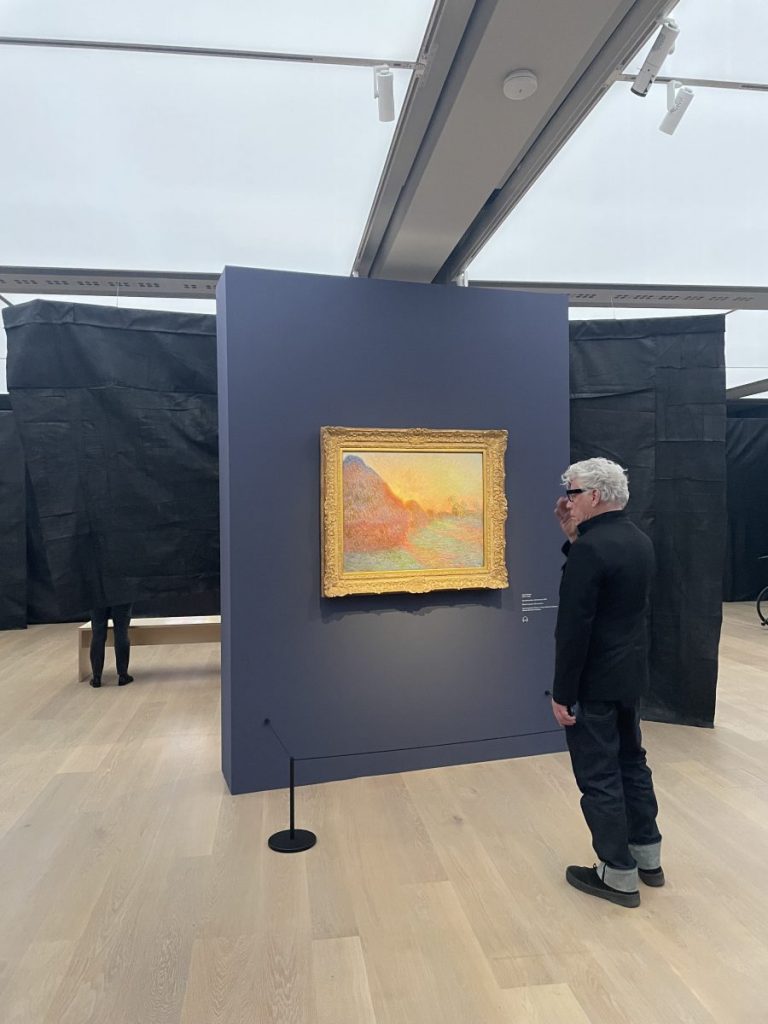
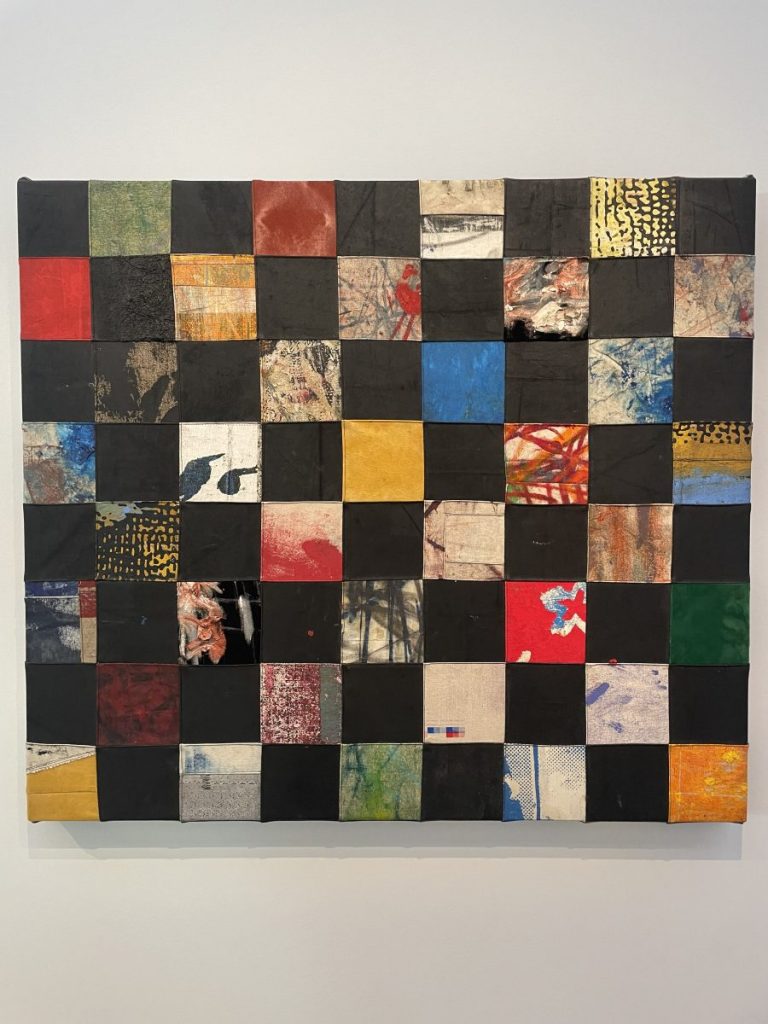
There is another interesting intervention with Monet in this show. You present three iconic paintings, Grainstacks, Water Lilies and House of Parliament, Sunset in a gallery within an architectural structure made of large black canvases. They belong to a group of works you first showed as long hanging drapes at the Venice Biennale in 2015. What’s the intention of draping them around Monet’s paintings now?
I think it does two things, which is important to acknowledge. Monet’s Parliament for example, is an incredible painting by a revered artist. Usually, when it hangs in the Barberini you see it in a completely different context. You admire the painterly virtuosity, or think about Monet’s obsession with that view, which he painted over and over again. It just happened to be a parliament building. Like the grainstacks, it's just another subject. But if you encounter it in this new context you ask yourself: Why ist this painting here? I'm zooming in on the image itself. After all, it’s the British Parliament. For me that building stands for politics, power, the collapse of political systems, and reflections on democracy. If you look at the colonial past of the UK, the history of the Empire, and the decisions that took place in that building. All these things still shape our world today.
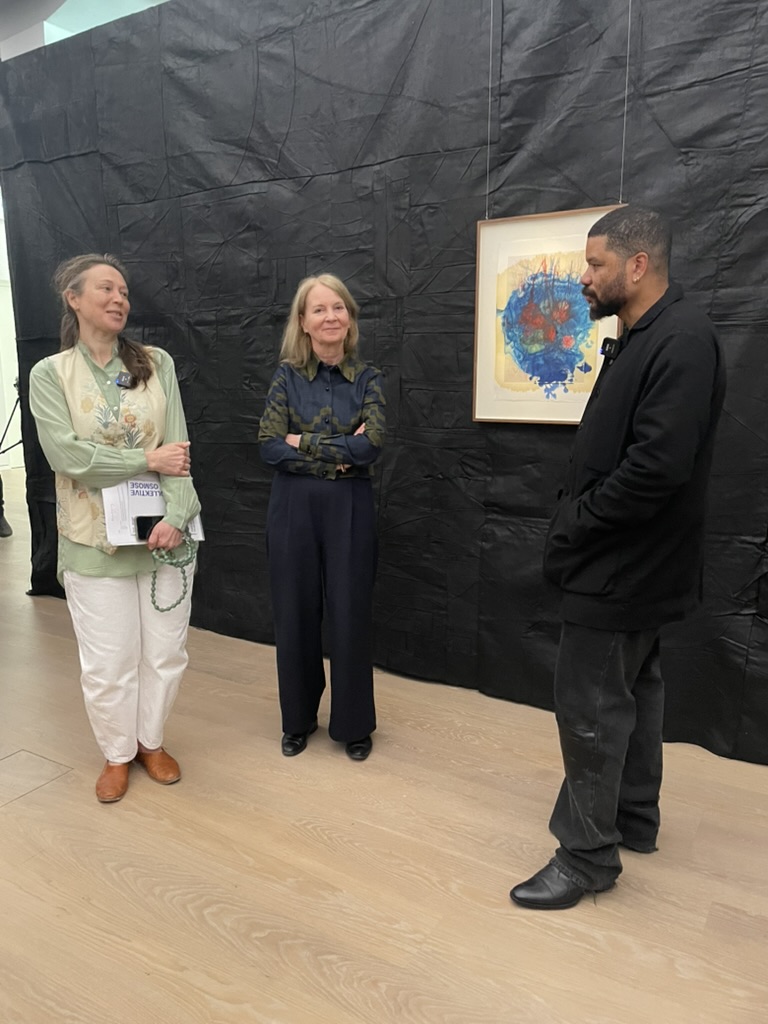
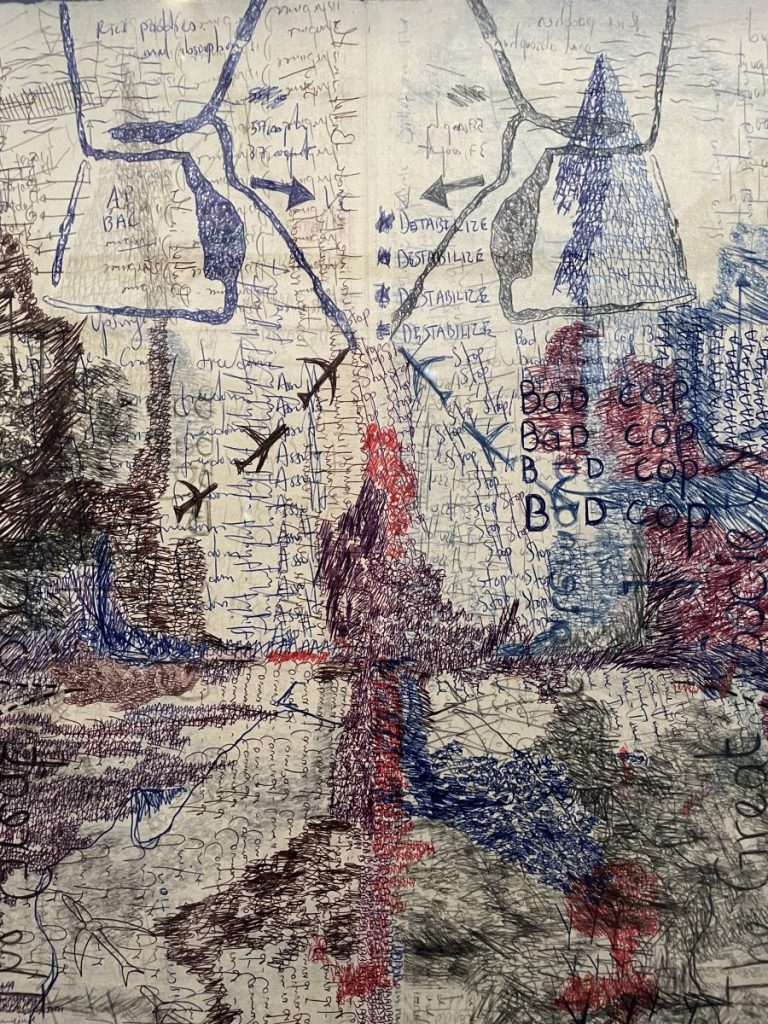
Recontextualizing Monet’s work is only one part of your exhibition in Potsdam. There is a whole room stacked with canvases from your ongoing Frequencies project. You invite school children to draw and doodle on professional-grade canvas you provide for their desks. After six month the canvases are collected and archived. What’s the idea behind that effort?
I’m running this mapping project in schools all over the world for more than ten years now. During all that time the simplicity of a piece of canvas and a pencil have created a special form of poetry, the expression of subconscious realities. For me this process is like downloading data from a collective imagination. I share the results in archive presentations, so audiences worldwide can observe the differences and similarities between children’s drawings, irrespective of their country of origin or socio-economic backgrounds. Here on the tables and shelves you can physically compare canvases from China, India, Turkey or Ukraine with canvases from schools in Potsdam. I am interested in pulling together all these different tensions for an audience to dive into at their own leisure.
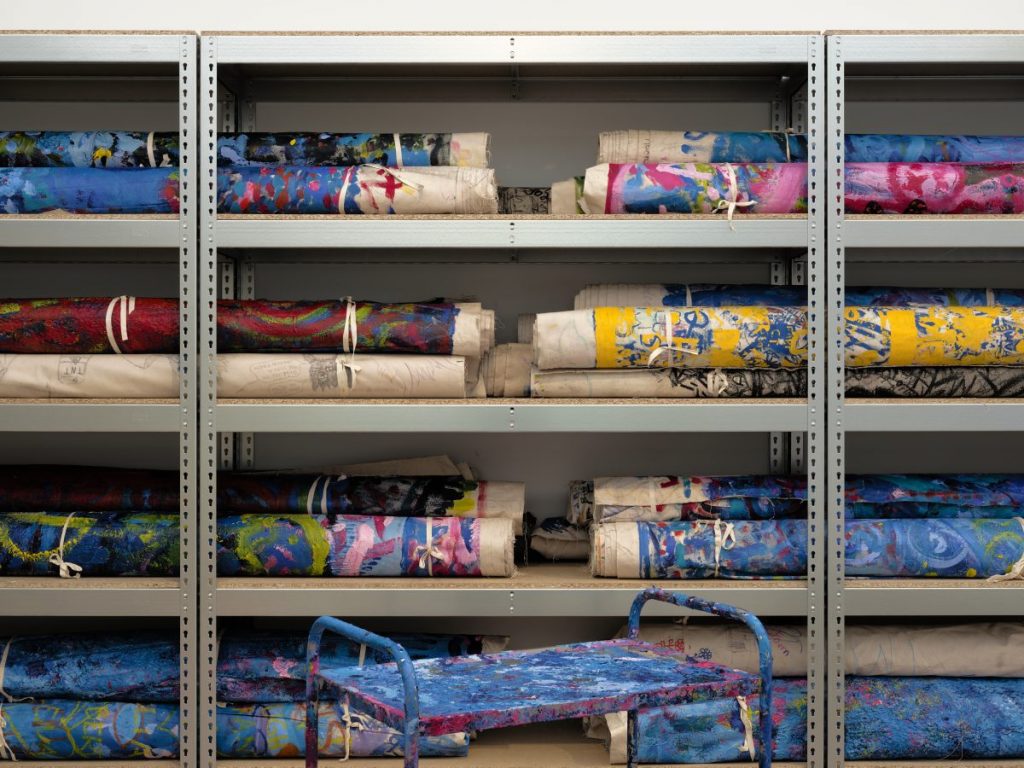
You also brought dozens of rolled-up canvases from an earlier collaborative painting event with you. They are from „The Flooded Garden“-project at Tate Modern in 2024, where tens of thousands of people participated in your „Social Mapping“ session at Turbine Hall. Will this now continue in Potsdam?
When Anna invited me, there was a desire to do something similar here. We thought about how we could get the participation of the public, how we could do it in an honest way. I think in London it was a total different situation. You know, the Tate is free, and it’s almost like this kind of museum that is in the streets. You can come in, hang out, even if you only want to go to the toilet. So it’s not just about art, it’s about the radicality of something being free that belongs to society and how society takes ownership. That was important for The Flooded Garden project. You have to have the capacity to get 80,000 people through. So the material that now is assembled here in the shelves, it's almost like this energy, this concentration and this kind of sedimentation of layers and layers and layers of people. We want to use it, but not in a performative way because it wouldn't work in the same way here. But there will be social mapping sessions in Potsdam too. We’ve already installed a large canvas in front of the museum which is from my last project at Sao Paulo Biennale. People can just come, day and night, and leave their marks on it.
OSCAR MURILLO. COLLECTIVE OSMOSIS
14.3.–9.8.2026 im DAS MINSK und MUSEUM BARBERINI in Potsdam, Deutschland
https://dasminsk.de/
https://www.museum-barberini.de/